


Research and Development in Powder Processing: From Characterisation to Industrial Scale-Up
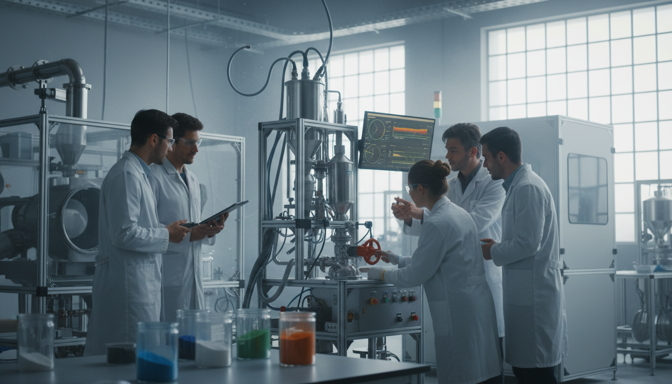
In industrial powder processing, research and development (R&D) is not limited to the design of new technologies. Its most important contribution lies in understanding how material properties interact with operating conditions and equipment, in order to develop reliable, reproducible processes suited to industrial-scale production.
Operations such as mixing, drying, agglomeration, milling, screening and compaction involve different physical phenomena, often influenced by variables that cannot be assessed in isolation. Particle size distribution, particle morphology, moisture content, bulk density and cohesion, for example, can all affect powder behaviour during processing and handling.
For this reason, an effective R&D approach must integrate particle science, process engineering, experimental testing and knowledge of actual operating conditions.
Powder Characterisation as the Starting Point
Before developing or modifying a process, it is essential to understand the material being handled. Two powders with a similar chemical composition can exhibit very different behaviours due to the physical characteristics of their particles and the way these particles interact.
The parameters that can be analysed include:
-
Particle size distribution: affects separation, mixing, milling and behaviour during conveying.
-
Particle morphology: particle shape and surface roughness can influence interparticle interactions and material handling.
-
Bulk density and tapped density: provide information about the degree of packing and volume changes during handling.
-
Moisture content: can promote the formation of liquid bridges, agglomeration and increased cohesion.
-
Flowability and shear strength: help assess material behaviour in hoppers, silos, feeders and feeding systems.
-
Tendency towards agglomeration and segregation: affects product homogeneity and the stability of operations.
Characterisation should not rely on a single index. Flowability, for example, is a complex behaviour: a test measuring flow through an orifice does not necessarily describe how a powder responds when subjected to consolidation or shear stresses. The choice of testing methods must therefore depend on the application and the conditions the material will encounter during processing.
From Theory to Experimental Testing
Theoretical models and simulations are important tools for understanding physical phenomena and guiding design. However, they cannot always represent every variable involved in an industrial process, particularly when materials are cohesive, abrasive or subject to changes over time.
Experimental testing makes it possible to verify the actual behaviour of the powder and compare different plant configurations. Tests can be carried out on material samples, laboratory equipment or pilot plants, depending on the complexity of the application.
During testing, it is possible to assess, among other aspects:
-
production capacity and feed rate stability;
-
mixing uniformity and product quality;
-
particle size distribution before and after processing;
-
agglomerate formation and segregation phenomena;
-
energy consumption and operating conditions;
-
wear of components in contact with the material;
-
dust emissions and containment;
-
ease of cleaning and cycle repeatability.
Defining test conditions is essential. Material quantity, moisture content, temperature, rotational speed, residence times and feeding methods must be controlled and documented. This ensures that results can be compared and used to identify the variables that have the greatest influence on the process.
Scale-Up: Transferring Results to Industrial Production
One of the most challenging stages of R&D is transferring results obtained in a laboratory or pilot plant to a larger production line.
Increasing equipment size or the quantity of material processed does not necessarily mean that the same performance levels will be maintained. Mixing conditions, heat transfer, residence times, stress distribution and material behaviour can all change as plant scale increases.
For this reason, scale-up requires the identification of the parameters governing the process and an assessment of how they interact. Depending on the operation, relevant factors may include:
-
ratio between usable volume and material quantity;
-
peripheral speed and operating regime;
-
intensity of mechanical stresses;
-
residence time and residence time distribution;
-
heat exchange capacity;
-
feed rate and flow continuity;
-
equipment geometry.
There is no single scale-up criterion that applies to every operation. The transfer must be based on the dominant physical phenomena and validated through successive tests, comparing performance at different scales.
A well-designed testing programme makes it possible to identify potential issues before final installation, reducing uncertainty when selecting equipment and sizing the production line.
R&D and Production Process Stability
Research and development is not concerned solely with the construction of new plants. It can also be used to solve problems that arise during the operation of existing production lines or following changes in raw materials and production conditions.
A change in particle size distribution or moisture content, for example, can alter material flowability, promote deposit formation or affect feed consistency. Similarly, a variation in the composition of a mixture can influence the homogeneity of the final product.
In these cases, a structured development process makes it possible to:
-
identify the problem and the conditions under which it occurs;
-
analyse material properties and process parameters;
-
formulate hypotheses about the causes of the phenomenon;
-
define targeted tests to verify these hypotheses;
-
compare possible solutions;
-
validate the selected configuration under conditions representative of actual production.
This approach makes it possible to address the root causes of a problem rather than simply correcting its effects. Documenting tests and results is also essential to ensure that solutions can be reproduced and knowledge transferred to subsequent plant design and management stages.
Energy Efficiency, Safety and Sustainability
R&D activities can also contribute to improving the energy and environmental performance of processes. However, assessments must be based on measurable parameters and reflect actual operating conditions.
Optimising processing times, reducing reprocessing, controlling material losses and correctly sizing equipment can all affect energy consumption and the overall efficiency of the production line.
Safety must also be considered from the earliest stages of development. Powder characteristics, the potential generation of explosive atmospheres, operator exposure and the containment of fugitive emissions can all influence technology selection and plant configuration.
Integrating these aspects into the experimental phase makes it possible to identify technical requirements at an earlier stage and avoid addressing safety and efficiency only after the plant solution has been defined.
How to Assess an R&D Project
When starting a new project or introducing a modification to an existing process, it is useful to check that the development programme includes clear objectives and measurable results.
The aspects to consider include:
-
availability of appropriate methods for material characterisation;
-
possibility of carrying out laboratory-scale and pilot-scale tests;
-
definition of the parameters to be monitored and the acceptance criteria;
-
representativeness of samples in relation to the material actually used;
-
documentation of operating conditions and results;
-
assessment of test reproducibility;
-
verification that results can be transferred to industrial scale.
The quality of an R&D project does not depend solely on the availability of a laboratory or testing equipment, but on the ability to connect experimental results with process and design decisions.
From Material Knowledge to Plant Reliability
In powder processing, every material has specific characteristics that can significantly influence equipment performance and production stability. For this reason, process development should not rely exclusively on nominal data or configurations already adopted in different applications.
Research and development provides the tools needed to analyse solids behaviour, verify design assumptions and define suitable operating conditions. Through characterisation, experimentation and scale-up, it helps reduce technical uncertainty and develop solutions that are better aligned with production requirements.
Integrating R&D throughout the plant lifecycle therefore means turning knowledge of powders into data-supported design and operational decisions, with potential benefits in terms of quality, production continuity, safety and efficiency.
Sources and Further Reading
1. Powder property characterisation – Fraunhofer IFAM – Powder Analysis. Methods for analysing particle size distribution, morphology, moisture content, density, porosity and flowability.
2. Flow properties and measurement methods – A Concise Summary of Powder Processing Methodologies for Flow Enhancement. Scientific review of the factors affecting flowability and the available characterisation techniques.
3. Influence of operating conditions on powders – KONA Powder and Particle Journal – The Effect of Process Conditions on Powder Flow Properties. Analysis of the effects of moisture, temperature and process conditions on powder behaviour.
4. Testing and transfer to production scale – Kansas State University – Powder and Bulk Solid Material Testing Services. Further information on laboratory, pilot-scale and industrial-scale testing.
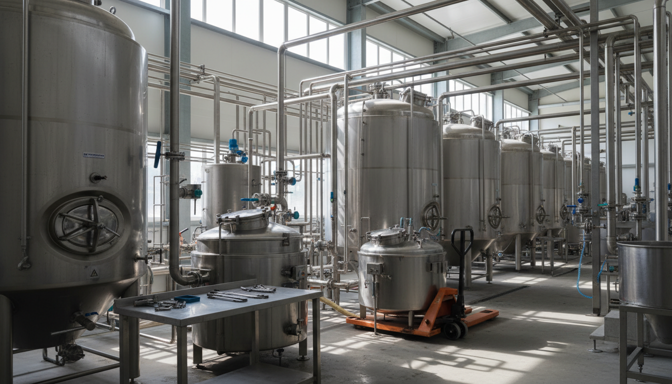
Hygienic Design of Processing Plants for Powders and Granular Ingredients in the Food Industry
Designing food processing plants for powders and granules: discover hygienic design criteria, stainless steel, conveying, dosing, cleaning and automation.
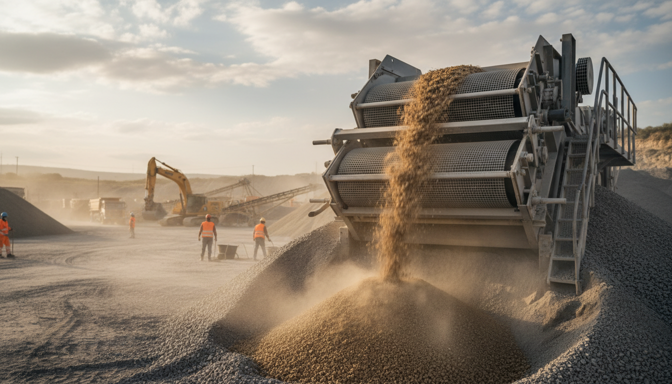
Discover how vibrating screens work and which innovations improve separation efficiency, maintenance and bulk solids classification.
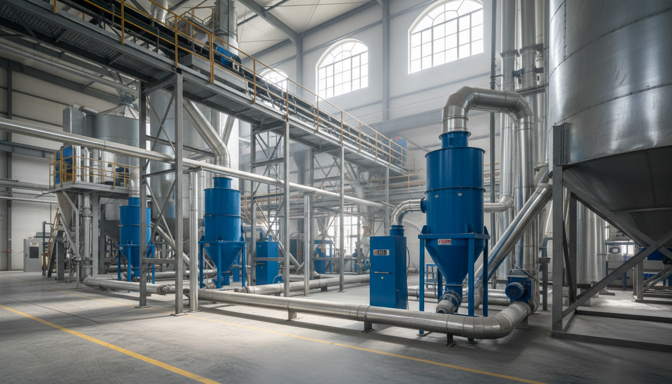
Industrial Filtration: Dust Control in Bulk Solids Handling Processes
Discover how to select and size industrial filtration systems to control dust in bulk solids handling, pneumatic conveying and storage processes.