


Industrial Filtration: Dust Control in Bulk Solids Handling Processes
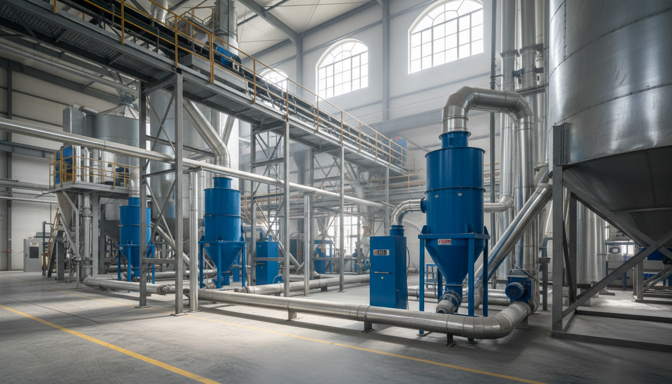
The handling of powders, granules and bulk materials inevitably generates airborne particles. Loading and unloading, transfer between equipment, pneumatic conveying and storage can all lead to fugitive emissions, material build-up and changes in operating conditions.
Dust control is not just a matter of air quality in the workplace. It also affects plant cleanliness, product preservation, equipment reliability and the management of risks associated with the materials being handled.
In this context, industrial filtration systems play an essential role: separating solid particles from the air generated or moved during the process, limiting dust dispersion and enabling controlled management of gas flows.
However, the choice and sizing of the technology must be based on the material’s properties, process conditions and the point at which the emission occurs.
1. Filtration During the Filling of Silos and Hoppers
Filling a silo or hopper displaces a volume of air corresponding to the material introduced. When the product is transferred through a pneumatic system, the air already present in the container is joined by the conveying air.
Without appropriate management of this flow, the outgoing air can carry dust particles into the surrounding environment. This is particularly relevant for fine materials, as even apparently controlled handling can generate a significant quantity of airborne particles.
Vent filters installed on silos and hoppers separate particles from the air displaced during filling. The flow passes through the filter media, which retains the particulate matter and allows the cleaned air to be discharged according to the plant configuration.
Sizing must take several parameters into account:
-
maximum airflow introduced during filling;
-
material feed rate and method;
-
particle size distribution and concentration of fine particles;
-
available filtration area;
-
filter pressure drop under different operating conditions;
-
cleaning method and discharge of the collected dust.
An undersized filter can cause internal pressure to rise and compromise the container’s operating conditions. For this reason, the filtration system must be designed in conjunction with the silo’s pneumatic and structural characteristics, including abnormal operating conditions.
2. Dust Extraction at Material Transfer Points
During mechanical handling, dust emissions often concentrate at points where the material changes direction or moves from one piece of equipment to another.
Belt conveyors, bucket elevators, screw conveyors, screens and loading hoppers can generate airborne particles as a result of material falling, impacts, changes in velocity and air displacement caused by the product flow.
In these applications, dust extraction is generally achieved through localised extraction systems. A hood or enclosure captures dust-laden air and conveys it to a filtration unit.
The design must take into account the geometry of the transfer point and the actual handling conditions. Excessive extraction airflow, for example, can carry away product particles that should remain in the process flow. Conversely, insufficient extraction can allow dust to escape through openings in the enclosure.
Factors to assess include:
-
the position and sizing of extraction points;
-
material drop height and flow rate;
-
transfer height;
-
enclosure dimensions and degree of closure;
-
airflow required to contain emissions;
-
pressure losses along the ductwork;
-
accessibility for inspection and maintenance.
Reducing the drop height, limiting openings and using appropriately designed hopper geometry can help reduce dust generation and dispersion at the source. Filtration is therefore part of a broader solution combining mechanical design with airflow control.
3. Filtration in Pneumatic Conveying Systems
In pneumatic conveying, air acts as the medium that moves material through a pipeline. At the end of the conveying route, the product must be separated from the gas stream before the air is recirculated or discharged.
Separation can be achieved using cyclones, filters or combinations of devices, depending on particle size, solids concentration and required performance.
In positive-pressure systems, air pushes the material towards the destination vessel. The conveying air must then be discharged while preventing fine particles from escaping into the surrounding environment. The filter installed on the silo or pneumatic receiver therefore plays an important role in separating the product from the air.
In vacuum systems, by contrast, air is drawn through the conveying circuit. An appropriate separation and filtration system is essential to limit the passage of particles towards the pump or vacuum generator, protecting sensitive components from wear and material build-up.
The filter selected must be compatible with the conveying regime and the product’s characteristics. In particular, the following factors must be considered:
-
solids concentration in the airflow;
-
particle size and density;
-
circuit flow rate and pressure;
-
air temperature and humidity;
-
material behaviour during separation;
-
required filtration efficiency;
-
recovery or disposal method for the retained product.
A correctly sized system helps maintain stable conveying conditions and protect equipment. Filtration should not, however, be treated as an isolated component: its performance also depends on pipeline configuration, preliminary material separation and the operating conditions of the entire circuit.
4. Filtration Integrated into Process Equipment
Equipment that directly handles bulk materials may also require dedicated extraction and filtration systems.
Mixers, dosing systems, screens, packaging machines and loading systems can generate dust during product feeding, processing or discharge. In these cases, dust extraction must be integrated into the machine or the relevant process area.
The aim is to capture particles where they are generated without interfering with equipment operation.
The configuration depends on the type of processing. In dosing systems, for example, extraction must be compatible with the required accuracy and must not remove a significant amount of product. In mixers, air displacement caused by the movement of internal components and changes in volume during loading must also be considered.
Product quality is another important factor. In the food, pharmaceutical and chemical sectors, the system must help prevent product contamination and allow cleaning procedures that meet hygiene and production requirements.
The design must therefore consider not only particle separation efficiency, but also:
-
compatibility of the filter media with the product;
-
potential for cross-contamination;
-
accessibility of filter elements;
-
cleaning and replacement procedures;
-
handling of recovered dust;
-
integration with product changeover procedures.
5. Filters, Filter Media and Cleaning Systems
The performance of a dust extraction system depends significantly on the choice of filter media and the system used to maintain its efficiency over time.
The main technologies include bag filters, cartridge filters and other textile or porous filter media. Selection depends on particle characteristics, temperature, humidity and operating conditions.
An important parameter is pressure drop, which is the difference in pressure between the dirty-air side and the clean-air side of the filter. During operation, particles accumulating on the filter media can increase resistance to airflow. If this is not managed properly, it can reduce extraction airflow and alter the plant’s operating conditions.
Various cleaning systems are used to limit dust build-up, including:
-
Compressed-air pulse cleaning: short pulses create an action that dislodges particles from the filter surface.
-
Mechanical cleaning: vibration or controlled movement helps remove the accumulated dust.
-
Shaker cleaning: the filter media is subjected to periodic movement, allowing some of the accumulated dust to be dislodged.
The choice depends on the filtration technology and the material’s behaviour. Damp, hygroscopic or highly cohesive powders can adhere to the filter media and make cleaning less effective. In these cases, selecting the filter media and managing operating conditions become critical.
Monitoring differential pressure makes it possible to detect changes in filter conditions and plan maintenance. However, the reading should be interpreted alongside airflow and fan operating conditions: an increase in pressure drop cannot always be attributed solely to filter-media clogging.
6. Centralised or Localised Dust Extraction?
A system may use filtration units dedicated to individual emission points or a centralised system that collects air from several areas through a duct network.
The choice depends on the number and distribution of extraction points, the required airflow rates and whether operations take place simultaneously.
Localised systems
Units installed directly near the emission point allow targeted intervention. They may be suitable when sources are spread across different areas or when operating conditions require each point to be managed independently.
Potential advantages include shorter duct runs, a more compact configuration and the ability to manage extraction requirements separately.
Centralised systems
A centralised system conveys extracted air from several points to a single filtration unit. This solution may be advantageous when there are many sources located relatively close together, or when a shared extraction network can be designed.
The design requires particular attention to airflow balancing, duct pressure losses and varying operating conditions. If several points operate simultaneously, the system must be sized for the actual operating scenarios.
There is no universally superior configuration. The choice must also take into account maintenance, available space, collected-dust handling and any need to keep different materials separate.
7. Safety: The Role of Filtration in Managing Combustible Dust
The presence of combustible dust introduces additional requirements for the design of handling and dust extraction systems.
Under certain conditions, a dispersion of combustible particles in air can create an explosive atmosphere. If an ignition source and conditions that allow propagation are also present, the event can have serious consequences for people and structures.
Filtration systems must therefore be included in the overall risk assessment. Collecting dust does not automatically eliminate the hazard: conditions that could lead to an explosion may also arise inside filters and dust collectors.
Depending on the material and area classification, the design must consider:
-
the dust’s explosion characteristics;
-
the potential for explosive atmospheres to form;
-
earthing and electrical bonding of equipment;
-
control of ignition sources;
-
any explosion isolation, venting or suppression systems required;
-
dust collection and discharge methods;
-
cleaning and maintenance procedures.
The assessment must cover the entire system, including extraction ductwork, filters, collection containers and connected equipment. Prevention and protection measures must be defined according to the material’s actual characteristics and operating conditions, in compliance with applicable requirements.
8. How to Size an Industrial Filtration System
An effective dust extraction system cannot be selected solely on the basis of filtration area or the collector’s nominal capacity. The process must be analysed as a whole, and the operating conditions the system will need to handle must be defined.
The key information to collect includes:
| Parameter | Technical considerations |
|---|---|
| Material handled | Particle size distribution, density, moisture, cohesiveness and abrasiveness |
| Dust generation | Particle concentration and emission method |
| Airflow | Volume to be treated under different operating conditions |
| Process conditions | Pressure, temperature and simultaneous operations |
| Filter media | Compatibility with the material and required separation efficiency |
| Filter cleaning | Cleaning technology and maintenance frequency |
| Pressure drop | Circuit resistance and fan operating conditions |
| Residue management | Recovery, recirculation or disposal of collected dust |
| Safety | Material hazards and need for specific protective measures |
Defining these parameters correctly helps avoid both undersizing, which can compromise dust extraction performance, and oversizing, which can lead to unnecessary energy consumption and capital costs.
Maintenance must also be considered at the design stage. Access to filter elements, availability of spare parts and the ability to monitor operating conditions all affect service continuity and total operating costs.
Conclusions
Industrial filtration is a fundamental component of bulk solids handling processes. From vent filters for silos to extraction systems at transfer points and air separation in pneumatic conveying circuits, each application requires a configuration suited to the material’s characteristics and operating conditions.
A properly designed system helps limit fugitive emissions, protect equipment, recover dispersed product and improve working conditions. However, results depend on the integration of filtration, mechanical design, airflow management and maintenance.
For this reason, dust extraction should not be treated as an add-on to be installed after a plant has been built. It should be integrated from the earliest stages of process design. This approach makes it possible to manage dust effectively while maintaining safety, reliability and production continuity over time.
Sources
- European Commission – Joint Research Centre, Emissions from Storage – Best Available Techniques Reference Document: guidance on filters for silos and hoppers, the management of displaced air during filling, and dust filtration: bureau-industrial-transformation.jrc.ec.europa.eu
- NIOSH, Dust Control Handbook for Industrial Minerals Mining and Processing: principles of dust control at transfer points, in conveying systems and during material-handling operations.
- Health and Safety Executive (HSE), Preventing dust explosions in the food industry: guidance on managing combustible dust, extraction, housekeeping, and separating dust from air in pneumatic systems.
- Occupational Safety and Health Administration (OSHA), Technical Manual – Combustible Dusts: information on the risks associated with combustible dust and relevant prevention and protection measures.
Hygienic Design of Processing Plants for Powders and Granular Ingredients in the Food Industry
Designing food processing plants for powders and granules: discover hygienic design criteria, stainless steel, conveying, dosing, cleaning and automation.

Research and Development in Powder Processing: From Characterisation to Industrial Scale-Up
Research and development in powder processing: discover how characterisation, experimental testing and scale-up improve the reliability and efficiency of industrial processes.
The Vibrating Screen Market: Growth, Challenges and Technological Innovations
Discover how vibrating screens work and which innovations improve separation efficiency, maintenance and bulk solids classification.