


Hygienic Design of Processing Plants for Powders and Granular Ingredients in the Food Industry
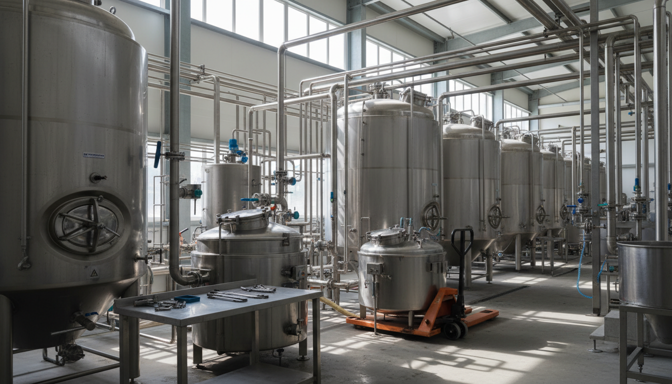
In the food industry, processing plant design must ensure the proper handling of raw materials, production continuity and control of contamination risks. When production involves powders, flour, starches, sugars, granular ingredients and dry blends, these requirements must be integrated with the specific characteristics of the materials and the methods used for handling and cleaning.
A bulk solids processing plant is not simply a collection of machines connected to one another. Silos, hoppers, conveyors, feeders, mixers, screens and packaging systems must be designed as parts of a single process, taking into account throughput, product properties, operating conditions, accessibility and hygiene requirements.
An integrated design approach makes it possible to assess interactions between equipment from the earliest stages and reduce the risk of feeding, accumulation, contamination or cleaning issues emerging only after the plant has been commissioned.
Design Starts with Raw Material Characteristics
The first step is to analyse the products that the plant will receive, store and process. The physical properties of powders and granules influence equipment selection and the sizing of handling systems.
The parameters to consider include:
-
Particle size distribution: affects segregation, mixing, filtration and behaviour during conveying.
-
Bulk density: influences the sizing of silos, hoppers and dosing systems.
-
Flowability and cohesion: determine how easily the material can be discharged and fed.
-
Moisture content and hygroscopicity: can promote agglomeration, adhesion to surfaces and deposit formation.
-
Abrasiveness: affects the choice of construction materials and the wear resistance of product-contact components.
-
Sensitivity to contamination: influences the selection of separation, cleaning and product protection solutions.
This information must be translated into design requirements. A fine, cohesive powder, for example, may require a specific hopper geometry and dedicated discharge devices. A hygroscopic ingredient may instead require particular attention to moisture control and the tightness of connections between equipment.
The design must also account for variations in raw material characteristics between batches, as these can affect material behaviour even when the plant configuration remains unchanged.
Designing an Integrated Process Line
A food processing plant for dry products generally comprises several stages, which must be sized and coordinated according to production capacity and the characteristics of the final product.
Receiving and storage
Raw materials may arrive in bags, big bags, road tankers or other transport systems. The choice of receiving method affects unloading operations, dust containment and connections to storage systems.
Silos and containers must be sized according to usable capacity, replenishment frequency, discharge characteristics and the need to protect the product from moisture and external contamination.
Conveying and handling
Material transfer can take place through pneumatic or mechanical systems, such as screw conveyors, bucket elevators and belt conveyors. The choice depends on material properties, conveying distance, required throughput and any sensitivity to particle breakage.
The design must minimise product losses, material accumulation and dead spots, providing accessible connections and suitable solutions for inspection and cleaning operations.
Dosing and weighing
Dosing accuracy is essential to maintaining consistent product formulations. Feeding system selection must take into account throughput, repeatability, bulk density and ingredient flowability.
Materials that are difficult to dose may require agitation devices, specific hopper geometries and flow control systems.
Mixing and processing
Mixers must be selected according to powder characteristics, product quantity and the required degree of homogeneity. Geometry, speed, mixing time and loading sequence can all affect the quality of the result.
Accessibility to internal components and the ability to remove residues are also important aspects of hygienic design.
Screening and product control
Screening can be used to separate out-of-specification particles, remove foreign bodies or control particle size distribution. The configuration must provide adequate capacity while allowing inspection of the screening surfaces and separation elements.
Packaging
In the final stage, the product is transferred to filling and packaging systems. It is important to maintain continuous flow, minimise dust dispersion and protect the product during transfer.
The design must therefore take the entire operating sequence into account, avoiding situations in which a single piece of equipment becomes a bottleneck for the production capacity of the line.
Stainless Steel and the Choice of Construction Materials
Stainless steel is widely used in food processing plants thanks to its corrosion resistance, the possibility of achieving surfaces suitable for cleaning and the availability of different metallurgical grades.
However, material selection should not be based solely on the generic designation of stainless steel. It must take into account the nature of the product, operating conditions, cleaning agents, temperature and the characteristics of cleaning cycles.
The aspects to assess include:
-
chemical compatibility with the product and cleaning agents;
-
corrosion resistance under the expected operating conditions;
-
surface finish of product-contact components;
-
weld quality and the absence of discontinuities that are difficult to clean;
-
compatibility of gaskets, seals and non-metallic components;
-
mechanical and wear resistance in areas subject to stress.
Surface geometry is equally important. Gaps, poorly designed joints, dead spaces and inaccessible areas can promote residue accumulation and make cleaning operations difficult.
Stainless steel alone, therefore, does not guarantee the hygienic safety of a plant: the outcome depends on the combined characteristics of materials, finishes, geometries, installation methods and operating procedures.
Hygienic Design: Cleanability and Contamination Prevention
Hygienic design aims to reduce the possibility of product contamination and ensure that cleaning operations are effective and verifiable.
In powder and granular material processing, the challenges can differ from those typically encountered in plants handling liquid products. Dry materials can accumulate in inaccessible areas, adhere to surfaces or form deposits in the presence of moisture.
Guidelines dedicated to the processing of dry particulate materials highlight the need to consider agglomerate formation, the presence of residues after plant shutdown and the risks associated with combustible dust.
The most important design criteria include:
-
minimising dead spaces and areas where material can accumulate;
-
ensuring access to internal surfaces for inspection and cleaning;
-
correctly designing gaskets and flexible connections;
-
limiting product losses and dust emissions;
-
selecting components compatible with cleaning procedures;
-
ensuring that residue removal can be effectively verified.
The risk of cross-contamination must also be assessed, particularly when the same line is used for different ingredients or products with specific requirements.
Design must therefore take into account not only routine cleaning, but also product changeovers, maintenance work and procedures for restoring the plant to operation after a shutdown.
Dry Cleaning and CIP Systems: Choosing According to the Process
The cleaning strategy must be defined during the design phase, rather than added as a secondary requirement once the plant has been completed.
In plants dedicated to dry materials, dry cleaning may be preferable to avoid introducing moisture, which could promote agglomerate formation, adherent deposits or conditions favourable to microbial growth.
Procedures may include industrial vacuum cleaning, controlled manual cleaning and components designed to facilitate access to internal areas. The actual methods must be defined according to the product, contamination risk and applicable hygiene requirements.
Wet cleaning may be necessary in certain applications, but it requires a design that allows for subsequent rinsing, drainage and drying of surfaces. Residual water in equipment not designed for this type of treatment can create operational and hygiene issues.
CIP (Cleaning in Place) systems allow certain equipment and circuits to be cleaned without dismantling them. However, their application must be assessed in relation to the type of plant and the process: they are not automatically suitable for every powder processing line.
Where used, cleaning cycles must be defined and validated by considering parameters such as detergent concentration, temperature, contact time and fluid distribution conditions. It is also necessary to verify that all surfaces are effectively reached and that no unwashed or poorly drained areas remain.
Process Automation and Control
The integration of equipment, instrumentation and automation systems makes it possible to manage different production stages in a coordinated way.
Level sensors, load cells, flow meters, temperature probes and pressure monitoring systems can provide useful information for monitoring operating conditions.
The control system can manage:
-
loading and unloading sequences;
-
ingredient dosing and weighing;
-
mixing times and parameters;
-
interlocks and safety conditions;
-
alarm management;
-
batch traceability and production parameter recording.
Data collection also makes it possible to verify recipe repeatability and identify any deviations from defined operating conditions.
To achieve effective integration, it is important to define the control architecture, interfaces between equipment and communication methods with company management systems from the outset.
Plant Safety and Maintenance Accessibility
Safety must be considered at every stage of the project, from raw material reception to packaging.
In plants handling combustible dust, the risk of explosive atmospheres must be assessed, identifying the areas concerned and defining appropriate technical and organisational measures.
Emission containment, equipment earthing, ignition source management and component selection must be consistent with the risk assessment and actual process conditions.
Accessibility for inspection and maintenance also plays an important role. Platforms, walkways, stairs and access points must be designed to allow operators to reach equipment safely, without compromising the cleanability of structures or creating surfaces where dust can accumulate.
Maintenance must be carried out without introducing product contamination risks or compromising the hygienic conditions of the line.
The Value of Integrated Design
Building a complete processing plant requires coordination between mechanical, electrical, plant engineering, automation and process engineering expertise.
An integrated project should start with the definition of production and hygiene requirements and progress through mass balances, process diagrams, equipment sizing, layout design, connection engineering and the definition of control logic.
Three-dimensional modelling can support the verification of equipment dimensions, access points and potential clashes between different components. Process and instrumentation diagrams, meanwhile, help define functional connections and control methods.
Before commissioning, it is important to plan installation checks, functional tests and performance assessments, as well as the documentation required for plant operation and maintenance.
Modularity can facilitate future expansions or changes in production capacity, provided it is considered during the initial design phase and does not compromise safety, cleanability or process stability.
An Efficient Plant Starts with Process Knowledge
Designing a food processing plant for powders and granular ingredients requires a balance between production performance, material characteristics, hygiene requirements and safety.
Equipment and construction material selection is only one part of the process. The quality of the result depends above all on the ability to integrate storage, handling, dosing, mixing, control and packaging into a coherent system.
A design approach based on product knowledge and actual operating conditions makes it possible to reduce material handling issues, facilitate cleaning, improve process repeatability and simplify maintenance activities.
Integrated design thus becomes an essential tool for developing reliable food processing plants that can be hygienically controlled and adapted to changing production requirements.
Sources and Further Reading
- Hygienic design for dry particulate materials – EHEDG – General Hygienic Design Criteria for the Safe Processing of Dry Particulate Materials. A specific reference for powders, agglomerates and granular materials, covering accumulation, contamination, cleaning and dust-related risks.
- Hygiene requirements for surfaces and equipment – Regulation (EC) No 852/2004 – Requirements for Equipment and Surfaces. Establishes general requirements for cleanability, maintenance and contamination prevention.
- Hygienic design of equipment for dry materials – Hygienic Design of Equipment in Handling Dry Materials. Technical overview of silos, pneumatic conveying, rotary valves, discharge systems and powder characteristics.
- Hygienic design guidelines – EHEDG – Guidelines Catalogue. Includes documents on dry materials, CIP systems, cleaning and disinfection.
- European food hygiene legislation – European Commission – Food Hygiene Legislation. Overview of the European provisions applicable to food production and processing.
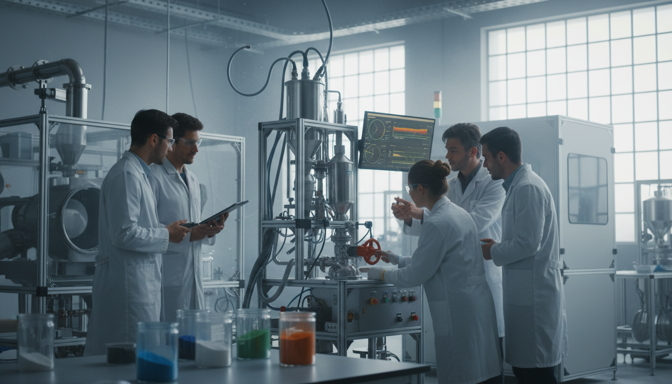
Research and development in powder processing: discover how characterisation, experimental testing and scale-up improve the reliability and efficiency of industrial processes.
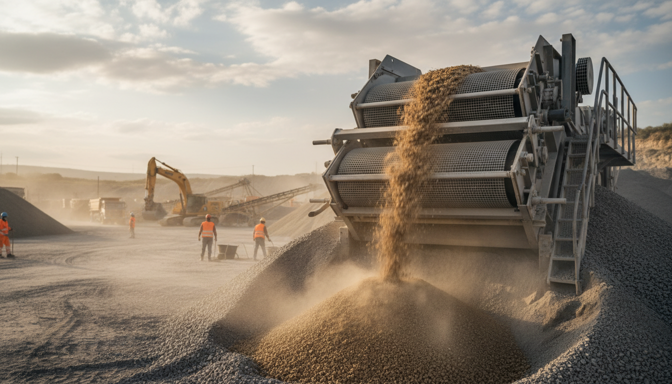
Discover how vibrating screens work and which innovations improve separation efficiency, maintenance and bulk solids classification.
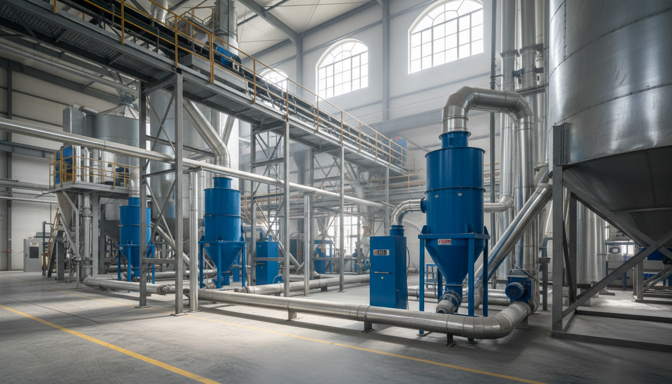
Industrial Filtration: Dust Control in Bulk Solids Handling Processes
Discover how to select and size industrial filtration systems to control dust in bulk solids handling, pneumatic conveying and storage processes.