Material blockages inside silos, hoppers and chutes are among the most common challenges in bulk solids handling. The problem affects more than production continuity: when material stops flowing, the interventions required to restore flow can introduce significant risks for operators and expose equipment to unexpected mechanical stress.
The issue must therefore be addressed by distinguishing between two closely related aspects: the cause of the loss of flowability and the method used to restore material flow.
Why Do Blockages Occur?
The formation of a bridge, a rat hole or a localised material build-up depends on the interaction between material properties and equipment geometry.
The most relevant parameters include:
- Particle size distribution (PSD).
- Particle shape and surface roughness.
- Bulk density.
- Moisture content.
- Cohesiveness.
- Temperature.
- Consolidation pressure.
- Wall angle.
- Material-to-wall friction coefficient.
- Outlet geometry.
Moisture, for example, can increase adhesion forces between particles and between the material and the wall. A change in PSD, on the other hand, can alter bed permeability and the material’s ability to maintain stable flow.
As a result, a silo that operates correctly with a particular raw material may experience bridging or rat-holing following a change in formulation, particle size distribution or environmental conditions.
The problem is therefore not necessarily attributable to the silo itself. It results from the interaction between material properties, geometry and operating conditions.
When Material Flow Stops
A bridge forms when particles develop a structure strong enough to support the weight of the material above it, preventing discharge.
In rat-holing, by contrast, the material tends to discharge through a central channel while a significant proportion remains attached to the walls.
Both phenomena can have significant operational consequences:
- Reduced or interrupted throughput.
- Changes in the bulk density of the discharged material.
- Segregation of the particle size distribution.
- Irregular feeding of downstream equipment.
- Increased downtime.
- The need for manual intervention.
Discharge system design must therefore account for the intended flow regime. The distinction between mass flow and funnel flow is fundamental to understanding how material will move through a container during discharge.
The Risks of Manual Intervention
When material becomes blocked, one of the most immediate responses is to intervene directly on the equipment: striking the walls, using rods or other tools to break up the build-up, or entering the container.
These practices can increase operational risks and, in some cases, make the problem worse.
Unexpected mechanical stress can damage walls, liners or supporting structures, while entering silos, hoppers and other enclosed spaces can expose operators to the hazards associated with confined spaces.
Technical guidance on managing blockages in bulk handling systems emphasises the need, wherever possible, to replace manual interventions with systems designed to operate from outside the equipment.
Air Cannons: Operating Principle
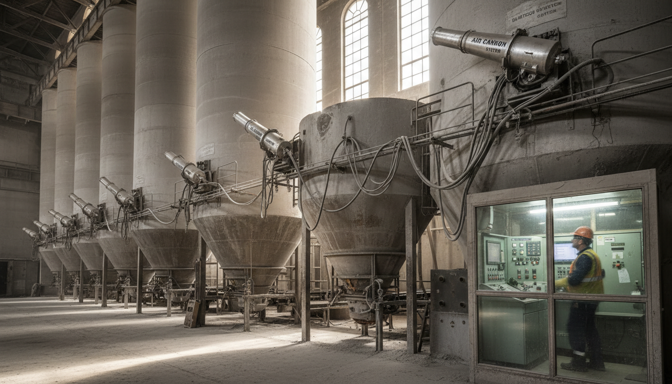
One technology used to help break up material build-ups is the compressed-air cannon.
The principle is relatively straightforward. A volume of air is stored under pressure and then released through a fast-acting valve. The resulting pulse creates a localised disturbance in the material, which can help break up consolidated structures and restore material mobility.
However, effectiveness depends on correctly configuring the system.
Nozzle positioning, tank volume, available pressure, pulse frequency and material characteristics must be assessed in relation to the equipment geometry and the specific blockage mechanism being addressed.
Indiscriminately applying high-energy pulses is therefore not a sound design strategy. An effective system must be sized according to the physics of the material and the behaviour of the process.
From Blockage Removal to Prevention
A more advanced approach is to avoid treating the flow-assistance system solely as an emergency device.
Monitoring operating conditions can help identify signals that precede flow interruption. Changes in throughput, an increase in intervention frequency, pressure variations or abnormal discharge times can indicate a progressive loss of flowability.
Integration with monitoring systems also makes it possible to record the frequency and duration of interventions, turning what was previously a reactive measure into a source of data about equipment performance.
This approach is particularly valuable in continuous processes, where preventing a single blockage can help avoid the shutdown of a larger production line.
Designing the System Around the Material
Blockage management should not begin with the selection of a flow-assistance device.
It should begin with material characterisation.
Shear testing, cohesiveness assessments, permeability analysis and the evaluation of frictional properties can provide useful information for determining outlet geometry, wall inclination and the most appropriate flow regime.
Material behaviour simulations can also help identify potentially critical areas before the plant is built.
In this context, the blockage-clearing system represents the final element in a design sequence that includes:
Material characterisation → Geometry design → Flow regime → Monitoring → Automatic intervention.
Treating these elements separately means addressing the symptom without tackling the underlying cause.
Safety and Operational Continuity
Blockage management in bulk solids systems must therefore be considered simultaneously as a flowability, safety and plant availability issue.
The most effective solution is not necessarily the one that generates the most powerful pulse. It is the one that reduces the likelihood of the material reaching a blocked state and, when necessary, restores flow without high-risk manual intervention.
For process engineers and plant managers, this means shifting the focus from simply removing an obstruction to understanding material behaviour throughout the entire system.
In bulk solids handling, a blockage is not merely a discharge problem.
It is the observable result of an imbalance between material properties, plant geometry and operating conditions.
Sources
- Dry Bulk Magazine — Safely Clearing Silo, Hopper and Chute Blockages. Read the article
- AT Minerals — POWTECH TECHNOPHARM 2026: In-Depth, Hands-On, Future-Ready. Read the article
- Global Mining Review — Safely Clearing Silo, Hopper and Chute Blockages. Read the article
- World Cement — Safely Clearing Silo, Hopper and Chute Blockages. Read the article