


Metalworking Production Capacity and Industrial Demand: Conflicting Signals for Manufacturing
- Redazione SOLIDS
- Market and Trends
- Cross-Sector
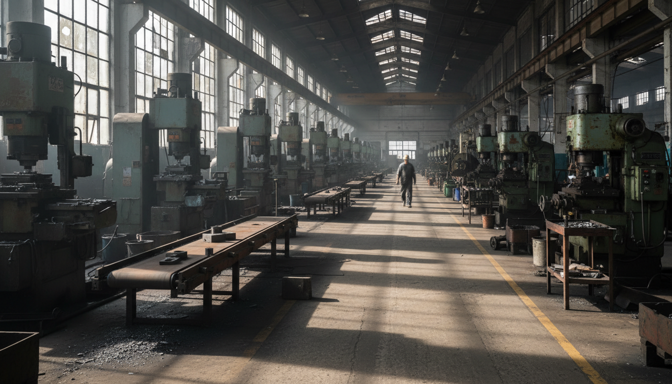
Unused production capacity is one of the most significant indicators for assessing pressure on industrial production. When plants operate substantially below their available capacity, the consequences extend beyond output volumes: asset utilisation and investment productivity decline, and companies often become less inclined to introduce new technologies.
Data available in 2026 point to a mixed picture. On the one hand, some metalworking segments are experiencing a sharp contraction in activity and demand. On the other, certain Italian manufacturing districts are showing signs of recovery. For industrial plants, this situation raises a broader question: how can competitiveness and efficiency be maintained when available production capacity exceeds actual market demand?
Production Capacity and Plant Utilisation
In July 2026, the Argentine Association of Metalworking Industries (ADIMRA) reported a production capacity utilisation rate of 39.2% for the metalworking sector, alongside a 5.5% contraction in the first seven months of the year. These figures point to significant underutilisation of industrial facilities and weak demand. ADIMRA – Metalworking production capacity data
The contraction was not uniform across the sector’s different segments. Capital goods declined by 9.5%, while agricultural machinery recorded a decrease of 7.7%. Electrical equipment and medical equipment also reported negative changes, of 4.3% and 3.9%, respectively.
The only exception identified in the analysis was the automotive parts segment, which grew by 1.9%.
These figures describe a problem that goes beyond a simple reduction in output. When production capacity is only partially utilised, a significant proportion of industrial assets remains available without being fully exploited.
For a plant, this changes the relationship between fixed costs, productivity and unit production costs.
When Demand Falls, Efficiency Takes on a Different Role
During periods of strong demand, the primary objective of a plant is often to maximise available production capacity.
When demand slows, priorities may change.
The challenge is not necessarily to produce more, but to produce economically and sustainably at lower operating loads, while maintaining high levels of reliability, quality and availability.
This is particularly relevant in plants characterised by numerous auxiliary systems and continuous or semi-continuous processes.
Pneumatic conveying, extraction, filtration, mechanical handling, dosing and storage systems may continue to consume energy and require maintenance even when production operates below nominal capacity.
A reduction in throughput does not automatically result in a proportional reduction in energy consumption.
A pneumatic conveying system, for example, may require a specific air velocity range to keep the material in stable conveying conditions. Similarly, extraction and filtration systems must maintain certain operating conditions, even when production does not change proportionally.
From this perspective, plant operational flexibility becomes a competitive factor.
The Challenge of Unused Capacity
Unused production capacity can be analysed at three levels.
First: asset utilisation.
Machinery, production lines and infrastructure represent invested capital that must be depreciated even when production levels decline.
Second: specific energy consumption.
When auxiliary systems are not adjusted to match the actual operating load, energy consumption per unit of product may increase.
Third: maintenance.
A plant operating under variable conditions may experience different wear patterns from those anticipated during the design phase. More frequent start-up and shutdown cycles, partial-load operation and flow-rate variations can alter the operating conditions of individual components.
For this reason, plant efficiency should not be assessed solely on the basis of its stated maximum capacity.
A more meaningful parameter is often the system’s ability to maintain stable performance across a wide operating-load range.
An Uneven Industrial Landscape
However, the available data do not indicate a uniform contraction in manufacturing activity.
One example is the province of Vicenza, where industrial production grew by 2.9% in the second quarter of 2026 compared with the previous three months and by 2.6% compared with the same period in 2025, according to the local Chamber of Commerce’s economic survey. VicenzaToday – Industrial production in Vicenza, Q2 2026
This figure does not justify generalising a recovery across the entire European manufacturing sector. It does, however, highlight an important point: production trends can differ significantly between sectors, regions and industrial supply chains.
For manufacturers of machinery and process technologies, this means that demand does not depend exclusively on the overall economic cycle. It also depends on the ability of individual companies to adapt their plants to changing operating conditions.
Process Flexibility as a Design Requirement
In a context characterised by fluctuating demand, plant design must therefore take a different perspective.
Nominal capacity remains important, but it must be complemented by the ability to operate efficiently at different throughput levels.
For systems handling bulk solids, this may require consideration of:
- Material flow-rate range.
- Variations in bulk density.
- Changes in particle size distribution.
- Material rheological behaviour.
- Conveying system control capabilities.
- Energy consumption under partial-load conditions.
- Extraction system management.
- The ability of dosing systems to maintain accuracy at different flow rates.
- Start-up and shutdown conditions.
- Maintenance requirements and component accessibility.
The concept of a design point becomes less sufficient when treated as a single nominal operating condition.
A plant designed to operate effectively across a range of conditions may prove more resilient than one sized exclusively for maximum capacity.
Energy Efficiency and Unit Costs
Plant underutilisation also makes the relationship between energy consumption and actual output more apparent.
When a production line operates at reduced capacity, some energy consumption may decrease proportionally with output, while other consumption remains relatively constant.
The result is an increase in specific energy consumption:
Energy consumed / Quantity of product
This indicator can be particularly relevant in bulk solids handling systems, where fans, compressors, extraction systems and pneumatic conveying equipment can account for a significant share of auxiliary energy consumption.
Efficiency assessments should therefore consider not only the equipment’s nominal energy consumption, but also its performance curve across the entire operating range.
From Maximum Throughput to Adaptability
Slowing industrial demand also changes how technology investments should be evaluated.
Under growth conditions, increasing capacity may be the primary objective.
When demand is uncertain, other parameters become more important:
Flexibility → Partial-load efficiency → Reliability → Maintenance → Specific energy consumption → Availability.
This shift directly affects bulk solids handling and processing systems.
A conveyor, dosing system, filter or pneumatic conveying installation should not be assessed exclusively on the basis of its maximum achievable capacity. Its ability to maintain controlled operating conditions as the process changes must also be considered.
Automation and Monitoring to Manage Variability
The availability of process data makes it possible to address this variability in a more structured way.
Monitoring flow rate, pressure, temperature, energy consumption, vibration and component status allows plant performance to be correlated with actual production levels.
In pneumatic conveying systems, for example, simultaneously monitoring pressure, flow rate and energy consumption can help identify suboptimal operating conditions before they result in performance losses or increased costs.
The same principle applies to filtration, extraction, dosing and mechanical handling systems.
The objective is not simply to collect more data, but to use data to determine how a system responds to changes in production load.
What This Means for the Bulk Solids Industry
The macroeconomic context translates into a series of increasingly relevant technical requirements for the bulk solids industry.
The ability to handle different materials, operate at variable flow rates, reduce specific energy consumption and maintain high reliability is becoming an integral part of plant competitiveness.
This is particularly relevant to sectors such as metalworking, chemicals, food processing, plastics, recycling, mining and machinery manufacturing, where the handling, dosing, storage and processing of powders and granules are essential stages of production.
Demand variability therefore does not eliminate the need to invest in technology. On the contrary, it can shift investment priorities away from simply expanding capacity towards optimising existing capacity.
Conclusions
The data available in 2026 show an industrial landscape characterised by differing trends. Some metalworking segments are operating at particularly low production capacity utilisation rates, while certain manufacturing regions are showing signs of recovery.
The situation therefore cannot be reduced to a single trend applying to the entire European industrial sector.
From an engineering perspective, however, one issue cuts across these different scenarios: production capacity must be matched by a plant’s ability to adapt.
For industrial systems handling bulk solids, this means designing and operating equipment capable of maintaining reliable performance not only at the nominal operating point, but across a realistic range of operating conditions.
In a market characterised by fluctuating demand, competitiveness depends on more than how much a plant can produce.
It also depends on how efficiently it can operate when it is not running at full capacity.
Sources
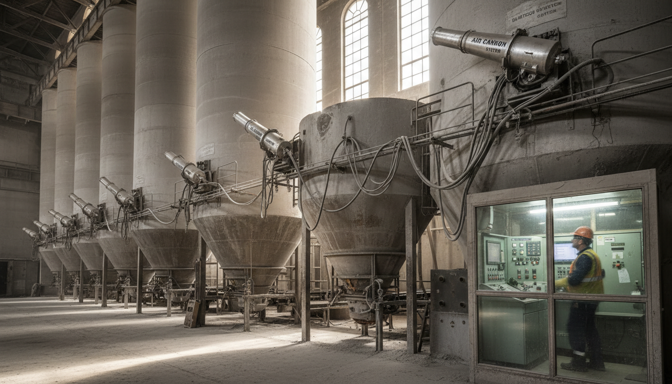
Material blockages inside silos, hoppers and chutes are one of the most common challenges in bulk solids handling.

Stainless Steel Containers for ATEX Environments: Design, Materials and Safety in Industrial Processes
How should a container be designed for an ATEX environment? Material selection, earthing, surface finish and area classification are just some of the factors to consider when ensuring safety and compatibility with the process.
Bulk Bag Unloading: Efficiency, Dust Containment and Handling Difficult Materials
How can bulk bag unloading be managed more effectively? Dust containment, discharge assistance and the handling of difficult materials are among the key factors to consider.