


Stainless Steel Containers for ATEX Environments: Design, Materials and Safety in Industrial Processes
- Redazione SOLIDS
- Processes and Material Handling, Industrial Safety, Storage and Logistics
- Cross-Sector
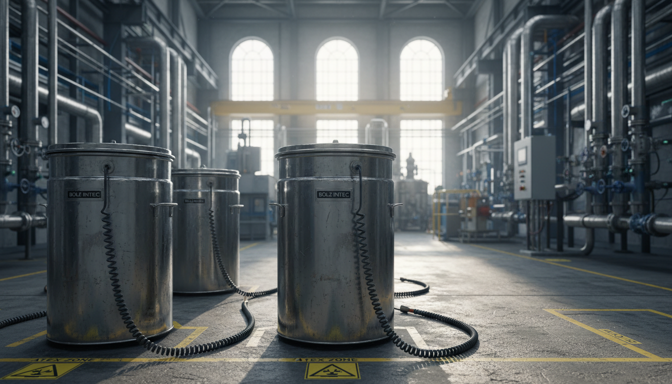
The design and use of containers intended for potentially explosive environments require an approach that considers product characteristics, operating conditions, area classification and the safety requirements of the entire plant.
In the chemical, pharmaceutical and wider industrial sectors, containers may be used for the storage, internal transport and processing of flammable substances, solvents, chemical intermediates, powders and other materials that may contribute to the formation of explosive atmospheres.
In these applications, ATEX compliance does not concern the vessel alone. Materials, connections, accessories, agitation systems, electrical devices and earthing arrangements must also be considered as part of the overall system design.
Area Classification and Container Design
The design of a container for an ATEX environment must begin with the classification of the installation and operating area.
For explosive atmospheres caused by gases, vapours or mists, the classification includes Zones 0, 1 and 2. For explosive atmospheres caused by combustible dusts, it includes Zones 20, 21 and 22. Equipment selection must be consistent with the relevant zone and the specific characteristics of the potentially explosive atmosphere.
For containers intended for these applications, the main regulatory reference for equipment and protective systems is Directive 2014/34/EU. For vessels falling within its scope, the requirements of Directive 2014/68/EU on pressure equipment may also apply.
Design considerations must therefore extend beyond the container’s volume to include operating pressure and temperature, product characteristics, filling and discharge methods, and interfaces with other plant components.
Electrostatic Charge Accumulation and Earthing
One of the fundamental aspects of ignition risk management is the control of electrostatic charges.
Electrostatic charges can be generated during the filling, emptying, transport or handling of materials. In the presence of an explosive atmosphere, a sufficiently energetic discharge can become a potential ignition source.
Container design must therefore incorporate appropriate earthing and equipotential bonding solutions, with verification of the electrical continuity of the relevant components.
The issue does not necessarily concern the vessel body alone. Connections, pipes, accessories, agitators and other integrated components must also be considered as part of the system to prevent unwanted potential differences from developing.
For this reason, conductivity and earthing checks are important elements of the technical documentation associated with the solution.
Stainless Steel and Material Selection
The choice of container material depends on the chemical and physical properties of the product and the process conditions.
Materials used include austenitic stainless steels such as 1.4404 (AISI 316L) and 1.4435, selected for applications requiring corrosion resistance and appropriate surface quality.
Under particularly aggressive conditions, special alloys such as Hastelloy C22 may also be considered when required by the process characteristics.
Material selection must not, however, be treated separately from vessel design. Chemical compatibility, temperature, pressure, product characteristics, cleaning frequency and hygienic requirements all contribute to determining the final solution.
Surface Finish and Cleanability
The quality of internal surfaces is particularly important in containers used for sensitive products, chemical intermediates or materials that may adhere to the walls.
A properly designed and treated surface can reduce residue build-up and facilitate cleaning. This is relevant both to process continuity and to the prevention of cross-contamination between batches or different products.
Design must therefore account for geometry, surface finish, welds, fittings and areas that are difficult to access during cleaning.
For processes involving powders, minimising material accumulation is also important from a risk management perspective. Deposited material must be assessed in relation to the characteristics of the dust and the plant’s operating conditions.
Containers for Powders, Liquids and Process Intermediates
ATEX container applications can vary considerably.
Possible configurations include:
- Containers for the internal transport of flammable substances.
- Process tanks for solvents and chemical intermediates.
- Vessels equipped with agitators.
- Pressure vessels for flammable fluids.
- Containers for powders and bulk materials in classified areas.
This diversity makes it difficult to define a standard configuration suitable for every application. Geometry, volume, materials, accessories and connection systems must be specified according to the operating conditions.
For bulk materials, additional properties such as particle size, density, flowability, cohesiveness and tendency to form deposits are also relevant, as they can affect product behaviour during filling and discharge.
Agitation and Accessory Integration
When a container also performs a process function, its design may require the integration of agitators and other auxiliary devices.
Integration must account for both process requirements and explosion protection. Mechanical and electrical components must be suitable for the environment in which they are installed and compatible with the area’s classification.
The same principle applies to valves, sensors, connections and other devices interfacing with the rest of the plant.
In an ATEX system, therefore, an accessory cannot be assessed as an independent component: its installation must be consistent with the overall design of the equipment and plant.
Customisation and Technical Documentation
Industrial applications frequently require containers designed to specific requirements. Parameters to consider include volume, product viscosity or physical properties, pressure and temperature conditions, filling and discharge methods, cleaning systems and integration requirements.
The design phase should therefore include a preliminary technical assessment, followed by the definition of the geometry, materials, surface finishes and required accessories.
Compliance and inspection documentation is also an essential part of the solution. Depending on the application, this may include material certificates, conductivity and earthing test results, declarations of conformity and documentation relating to the inspections performed.
These documents ensure that equipment characteristics remain traceable and support the technical and documentary management of the plant.
ATEX Safety as a System Requirement
A container intended for a potentially explosive environment should not be considered in isolation from the process.
Safety depends on the interaction between the vessel, the product, operating conditions, connections, auxiliary devices and installation environment. For this reason, design must begin with an assessment of actual operating conditions and the classification of the area.
This approach is particularly important in applications involving combustible dusts. Material behaviour, the potential formation of dust clouds or deposits, handling methods and ignition sources must all be assessed as part of the overall risk analysis.
Conclusions
Containers intended for ATEX environments require a design approach in which materials, geometry, earthing, accessories and process conditions are treated as components of a single system.
Stainless steel and special alloys can meet different chemical resistance and process requirements, while surface and geometric design contribute to cleanability and residue management.
In applications involving powders and bulk solids, these considerations must also be integrated with the specific challenges of material handling and combustible dust containment.
The proper design of an ATEX container therefore begins with defining operating conditions and classifying the area, then proceeds to selecting the materials, accessories and control systems needed to ensure that the complete solution is compatible with the industrial process.
Sources
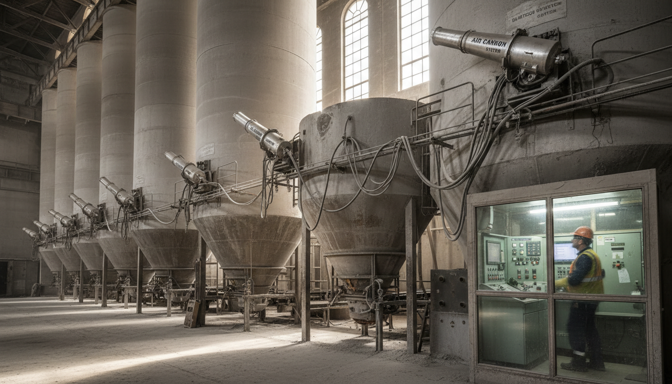
Material blockages inside silos, hoppers and chutes are one of the most common challenges in bulk solids handling.
The metalworking sector’s production capacity is showing mixed signals: weak demand continues to constrain plant utilisation, while some manufacturing regions are showing signs of recovery. This reflects the differing operating conditions and market dynamics across European industry.
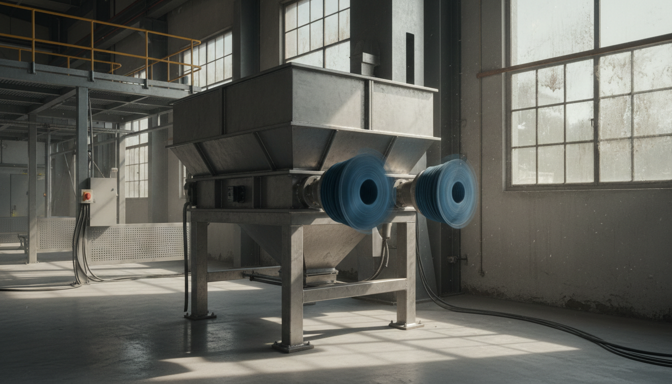
Bulk Bag Unloading: Efficiency, Dust Containment and Handling Difficult Materials
How can bulk bag unloading be managed more effectively? Dust containment, discharge assistance and the handling of difficult materials are among the key factors to consider.